VfB Stuttgart 1893
Five titles, no European trophy, and a century of unapologetic Swabian pride.

VfB Stuttgart · Public domain
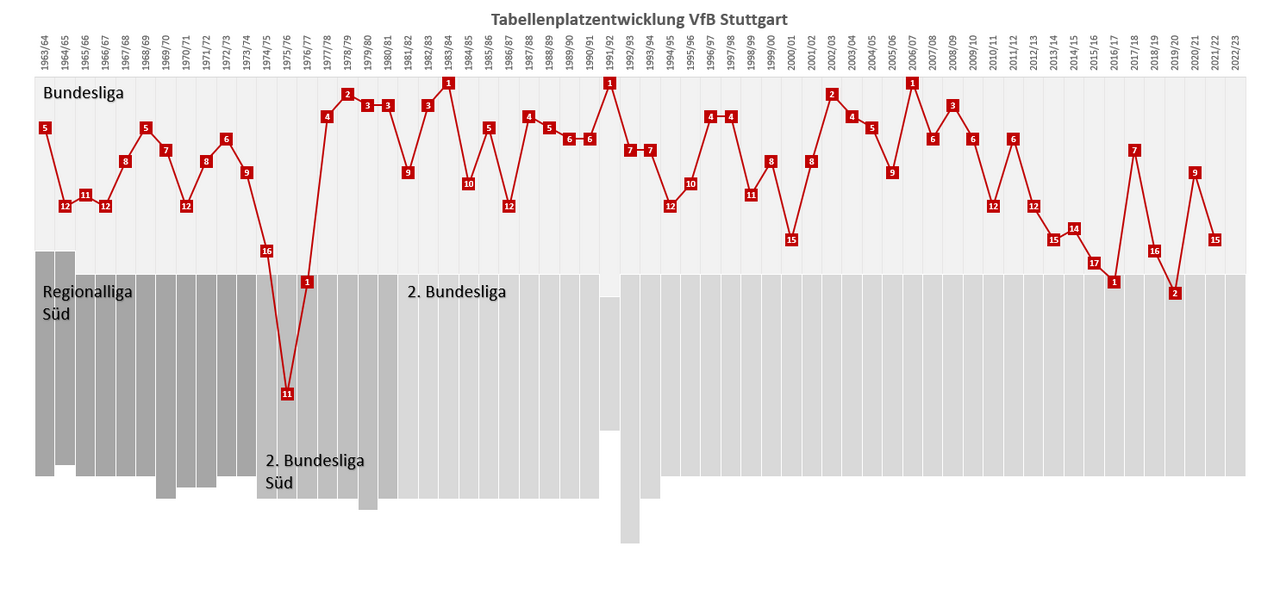
VfB Stuttgart 1893 e. V. — known to the world as VfB Stuttgart, and to their own faithful simply as 'die Schwaben' — is one of Germany's most storied football clubs. The modern club was formed in 1912 from a merger, and its roots trace back to 9 September 1893 in the industrial city of Stuttgart, Baden-Württemberg. Carrying the white-and-red colours of the Swabian heartland for over a century, the club has built an identity rooted in local pride, disciplined teamwork, and an unapologetic regional character that sets them apart from the German football establishment. As a founding member of the Bundesliga in 1963, Stuttgart has been a constant presence in German top-flight football. Their trophy cabinet holds five league titles and four DFB-Pokal cups, while their all-time record scorer, Karl Allgöwer, is the club's leading Bundesliga marksman with 129 goals. For the fans who fill the stands in Stuttgart, the club is not merely a team but a civic institution — a Swabian statement in a league long dominated by Munich, Dortmund, and the Rhineland.
- League titles
- 5 (1950, 1952, 1984, 1992, 2007)
- UEFA Cup
- 0 (never won)
Lore & Background
The story of VfB Stuttgart begins in the workshops and factories of a city that built engines and, later, champions. Founded in 1893 by young men who wanted a club of their own in Stuttgart, the team grew from local park football into a serious competitor in the German championship system. The modern VfB Stuttgart was formed in 1912 from a merger, solidifying the club's identity. By the time the Bundesliga was launched in 1963, Stuttgart was already a name to be reckoned with, and their immediate inclusion among the founding sixteen clubs was no accident. The club's golden age arrived in the 1980s, a decade that still defines the modern identity of the team. That era produced a style of football that was direct, hard-working, and unmistakably Swabian: no frills, no excuses, just results. For the Stuttgart faithful, beating Hoffenheim is not optional; it is a matter of regional honour. And when the team lifts the cup — whether in the Bundesliga or in European competition — the celebration in Stuttgart carries a particular, almost defiant joy, as if the city is reminding the rest of Germany that the best football does not always come from the biggest budgets.
In Their Own Story
The floodlights hum to life over the pitch in Stuttgart, and the air smells of wet grass and hot bratwurst from the stands. Klaus Fischer, number 11, stands at the edge of the box, eyes tracking the ball as it arcs from a corner kick. The keeper guesses left. Fischer does not. He simply rises, times his header with the mechanical precision of a watchmaker, and the ball thuds into the net. The stadium detonates. In the lower tier, a young factory worker in a steel-toe cap presses his palms together, breathless, as if the goal has been scored for him personally. Around him, strangers embrace. For ninety minutes, Stuttgart is the centre of the football world, and no one in that crowd will ever forget the sound.
Reader's Guide
Captain Manfred Kalt anchored the midfield with a tenacity that became the club's spiritual emblem. The team played a direct, high-pressing game that contrasted sharply with the more technical styles of Bayern Munich and Hamburg. Why it matters to the club's identity: This period cemented VfB Stuttgart as a genuine title contender, not a mid-table curiosity. It proved that a club from a mid-sized industrial city could outwork, out-discipline, and out-score the giants. The 'Swabian way' — pragmatic, collective, unshowy — became the philosophical core that every subsequent generation of players and coaches has been measured against. When a Stuttgart fan says 'wir sind die Schwaben,' they are invoking this era: the years when the white-and-red shirt was a promise of something honest, hard-earned, and entirely their own. The 1989 UEFA Cup final against Inter Milan, won on penalties, remains the high-water mark of Stuttgart's European journey and the match that made the club a name across the continent.
Did You Know?
- VfB Stuttgart was one of the original 16 founding members of the Bundesliga when the competition launched in 1963, a testament to the club's established status in German football.
- The 1989 UEFA Cup final against Napoli was a two-legged tie that Stuttgart lost 5-4 on aggregate (2-1 at home, 3-1 away), with goalkeeper Eike Immel between the posts. Stuttgart have never won the UEFA Cup; their only Eu
- The club's nickname 'Die Schwaben' reflects not just their home city of Stuttgart but the broader cultural identity of the Swabian region, a point of fierce local pride that fans consider inseparable from the team.
Dominance in the Amateur Leagues
VfB Stuttgart II's early identity was forged in the amateur leagues of Württemberg. After first appearing in the third division Amateurliga Württemberg in the 1959–60 season and winning it outright, the club found itself in the Amateurliga Nordwürttemberg following a split into two regional divisions. There, from 1962 through 1967, the side became a near-untouchable force, claiming four league titles across just five seasons. A fifth championship followed in 1971. Yet despite this sustained excellence, the club was repeatedly barred from promotion to the professional tiers above, a frustration that defined much of its early history. The team stayed in this league until 1978, generally achieving top-of-the-table finishes but missing out on qualification for the new Oberliga Baden-Württemberg by a single point when it came sixth, with a top-five finish required. The team's league successes also earned it entry into the German amateur football championship, where it triumphed in 1963 by defeating VfL Wolfsburg and again in 1980 by beating FC Augsburg in the final. A 1971 final appearance ended in disappointment, with a loss to SC Jülich 1910.
A Long Climb Through the Tiers
The path to professional football was anything but straightforward. After winning the Oberliga in its first season there, following promotion from the Verbandsliga in 1979, the team was once again denied a step up. It finished second the following year before suffering relegation in 1988. A return to the Oberliga came in 1990, but when the Regionalliga Süd was introduced as the new third tier in 1994, the club failed to qualify. Promotion arrived in 1998 after another Oberliga title, only for the team to drop back down in 2002. A 2003 Oberliga championship secured a second spell in the Regionalliga lasting five seasons. The breakthrough finally came in 2008, when the club earned a place in the newly created 3. Liga. It spent eight seasons in that division, typically as a mid- or lower-table side, before finishing last in 2015–16 and dropping to the Regionalliga Südwest. The introduction of the Regionalligas in 1994 and the 3. Liga in 2008 each caused all lower leagues to drop one tier, reshaping the competitive landscape the team navigated.
A Pipeline for the First Team
VfB Stuttgart II functions as the reserve squad for the senior club, serving as a critical bridge between the youth academy and the Bundesliga first team. The squad's core is built from recent graduates of Stuttgart's youth setup, supplemented by established older players who fall just short of first-team quality. When a young player stands out at the reserve level, the pathway to promotion is well established. Sami Khedira provides a vivid illustration: in the 2006–07 season he made nine league appearances for Stuttgart II, his last on 24 September 2006. Just one week later, on 1 October 2006, he made his Bundesliga debut for the senior side. This developmental role has been central to the club's identity since it operated under the name VfB Stuttgart Amateure until 2005, when the rebranding to Stuttgart II reflected its formal status as the reserve team of the professional club.
Grounds and Cup Memories
The team's home ground story is one of practical necessity. The Robert-Schlienz-Stadion, a 5,000-capacity all-standing venue, served as home from its opening in 1995 until 2008. Originally called the Amateur-Stadion, it was renamed in honour of the well-known VfB player Robert Schlienz after his death in June 1995; the first match there was a youth championship second-round game on 25 June 1995. When the 3. Liga requirements exceeded the stadium's capacity, the club relocated to the larger Gazi-Stadion auf der Waldau. After relegation in 2016, it returned to the Robert-Schlienz-Stadion, which now also hosts the A and B youth teams. For the 2024–25 3. Liga season, the team moved again to the WIRmachenDRUCK Arena in Aspach, with a capacity of 10,001. In cup history, a memorable 2000–01 first-round 6–1 victory over Bundesliga side Eintracht Frankfurt was followed by a 3–0 loss to their own first team in the second round.
Gallery
Frequently Asked Questions
What is VfB Stuttgart 1893?
VfB Stuttgart 1893 e.V. is the full legal name of the professional football club most people simply call VfB Stuttgart, based in Stuttgart, Baden-Württemberg. The "1893" in the title marks the year the club was established, on 9 September of that year. Locals and devoted supporters affectionately refer to the side as "die Schwaben," a direct nod to the club's deep Swabian roots.
How many league titles does VfB Stuttgart have?
Stuttgart have won six top-flight championships in total, including the 1950 title from the pre-Bundesliga era. They were also among the original clubs admitted to the Bundesliga when it launched in 1963, giving them a continuous link to Germany's top division for over six decades.
What are VfB Stuttgart's colours and why are they significant?
The club plays in white and red, a palette that mirrors the identity of the Swabian heartland. Those colours, paired with the nickname "die Schwaben," reinforce a proudly regional character that sets Stuttgart apart from the broader German football establishment.
Why is VfB Stuttgart important in German football history?
As a founding member of the Bundesliga in 1963, Stuttgart helped build the framework of modern German top-flight football from its very first season. More than a century of continuous existence and sustained presence in the top division make them one of the most historically significant clubs in the country.
More in Club History
Elsewhere in the VfB Stuttgart universe
Spotted an error? Know more?
This is a living reference — every entry is fact-audited, and reader corrections feed straight into our audit queue. Suggest an edit · See this site's audit record